- green-spots
- land restoration
- China
- Three-North Shelter Forest Program
Problems
The expanding Gobi Desert
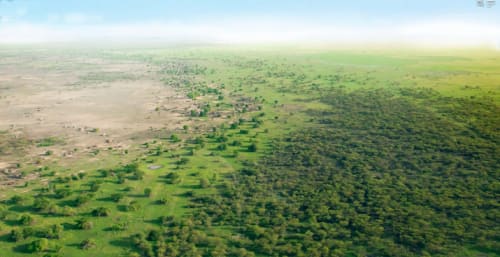
Desertification is a global problem. China has seen 3,600 km2 (1,400 sq mi) of grassland overtaken every year by the Gobi Desert. Dust storms blow off as much as 2,000 km2 (800 sq mi) of topsoil each year, increasing in severity yearly.

The sandstorms and soil erosion caused by desertification have damaged the local environment and economy and affected neighboring countries and regions, such as Japan, Korea, and Southeast Asia.

Deforestation, overgrazing, and overuse of water by people are some of the leading factors responsible for desertification. In China, the problem has been occurring along four types: "aeolian desertification," which is caused by wind erosion after vegetation is destroyed; "water and soil loss," due to water erosion that is mainly distributed in the Loess plateau; "salinization" due to poor water management; and "rock desertification,” distributed in the Karst region of southwestern China.
Solutions
How the three-north shelter forest program is helping combat desertification
However, China is fighting back against the encroaching desert – in fact, it has been for decades. The Three-North Shelter Forest Programme was started in 1978 as part of an ambitious proposal to plant 4,500 kilometers of wind-breaking forest strips to halt the advance of the Gobi Desert. The results so far have been mixed.

It is the world’s largest afforestation project, aiming to create a series of human-planted windbreaks and sand-fixing forests along the northern borders of China, covering 13 provinces and autonomous regions. The project is expected to be completed by 2050, by which time it will span 4,500 kilometers (2,800 miles) in length and cover an area of 35.6 million hectares (88 million acres).

The main objectives of the TNSFP are to prevent the expansion of the deserts, reduce the frequency and intensity of sandstorms, improve the microclimate and soil quality, conserve water resources and biodiversity, provide timber and other products to the local population, and mitigate the effects of global warming by sequestering carbon dioxide.

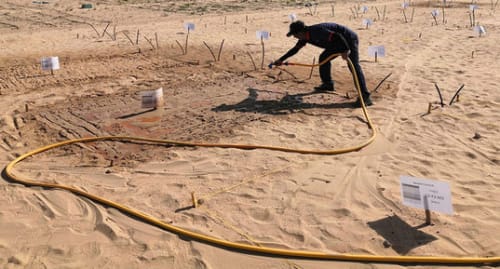
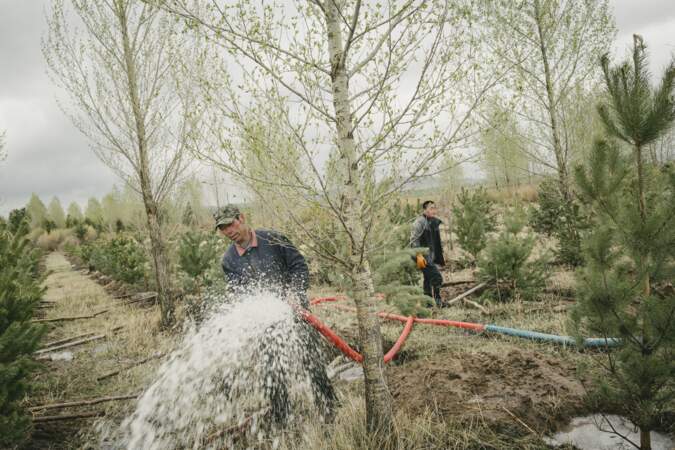
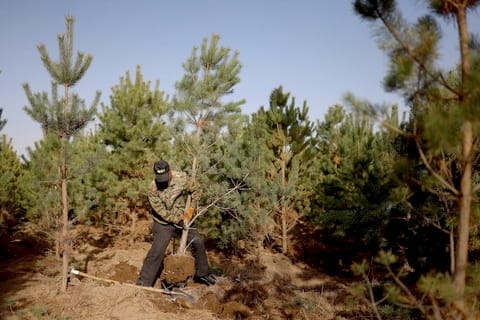
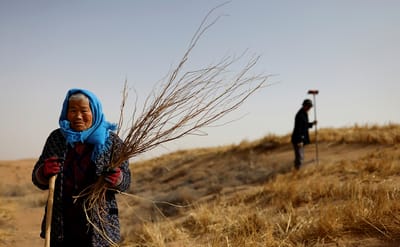
The TNSFP has adopted various methods of ecological restoration, such as aerial seeding, planting trees and shrubs by hand, establishing fruit tree plantations, grassland restoration, and constructing check dams and terraces. The choice of species and techniques depends on each region's local conditions and needs. Some common species used in the project are poplar, willow, elm, pine, spruce, sea buckthorn, caragana, alfalfa, licorice, and saxaul.

Great achievements have been made in the implementation of the “Three North Program” for more than 40 years. The ecological situation of the program area has been significantly improved, and the annual value of forest ecosystem services has reached 2.34 trillion yuan, which has played an important role in maintaining national ecological security and promoting economic and social development.

The Chinese government claims that the program has led to the planting of 66 billion trees across 13 provinces. Although the exact level of forestry cover is difficult to measure, desertification is slowing. Certainly, China can point to several success stories on a smaller scale.

The frequency of sandstorms had decreased by more than 20% since 2000. The annual average net primary productivity has increased by 34% since 1981. The carbon sequestration potential had reached 7.6 billion tons by 2010. The ecological benefits of the project were estimated to be worth 615 billion yuan (about $89 billion) per year.

However, opponents of the Three-North initiative point to the fact that while many of the planted trees are good for boosting statistics, they are not particularly helpful for long-term reforestation. As of 2008, a fifth of the planted trees had died.

Others have also criticized the decision to plant a limited range of tree species, usually the most profitable ones. Monoculture afforestation leaves forests vulnerable to disease, and a focus on high-value timber may not restore the ecological variety that once existed in a particular region.
Gallery
4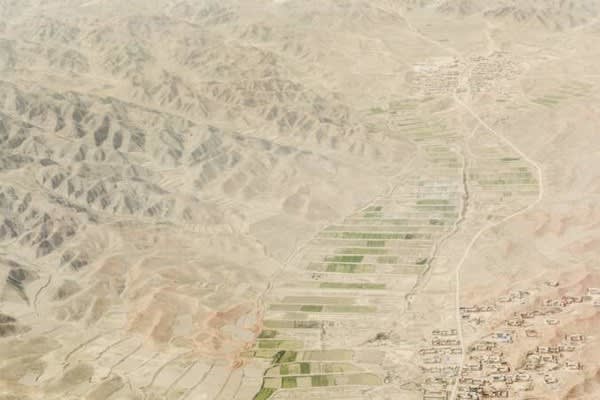
Timelines
1978
The Chinese government launched the TNSFP, which covers 13 provinces and autonomous regions across northern China with a total area of 4.069 million km2. A 72-year development plan was formulated for the TNSFP, in which the program was divided into three stages, aiming at increasing the forest cover from 5.05% to 14.95% in the area.
1985
The first stage of the TNSFP was implemented, focusing on planting trees and shrubs along the main wind-sand corridors and establishing shelterbelts around farmlands and settlements. About 4.07 million ha of forests were planted during this period.
2003
The fourth phase of the project started and has two parts: aerial seeding to cover wide swathes of land where the soil is less arid and offering cash incentives to farmers to plant trees and shrubs in more arid areas. A $1.2 billion oversight system (including mapping and surveillance databases) will also be implemented. The "wall" will have a belt with sand-tolerant vegetation arranged in checkerboard patterns to stabilize the dunes. A gravel platform will be next to the vegetation to hold down sand and encourage a soil crust to form. The trees should also serve as a windbreak from dust storms.
2008
Winter storms destroyed 10% of the new forest stock, causing the World Bank to advise China to focus more on quality rather than quantity in its stock species.
2009
China's planted forest covered more than 500,000 square kilometers (increasing tree cover from 12% to 18%) – the largest artificial forest in the world.
2018
The United States National Oceanic and Atmospheric Administration found the increase in forest coverage observed by satellites is consistent with the Chinese government data. According to Shixiong Cao, an ecologist at Beijing Forestry University, the Chinese government recognized the water shortage problem in arid regions and changed the approach to plant vegetation with lower water requirements. Zhang Jianlong, head of the forestry department, told the media that the goal was to sustain the health of vegetation and choose suitable plant species and irrigation techniques.
2020
According to a BBC News report, tree plantation programs resulted in significant carbon dioxide absorption and helped mitigate climate change. The benefit of tree planting was underestimated by previous research.
2022
Three-North Shelter Forest Program also reversed the desertification of the Gobi desert, which grew 10,000 square kilometers per year in the 1980s but was shrinking by more than 2,000 square kilometers per year in 2022.
2024
November
China's government reported that after 46 years of work, it had finished the 3,000-kilometer green belt around the Taklamakan Desert.

The country's forest coverage grew from 10% of the overall territory in 1949 to 25% in 2024; the green belt project contributed to this achievement.

Although the country's desert coverage was still 26.8% in 2024, this was down slightly from 27.2% a decade previously.

To date, at least 30 million hectares of trees have been planted.

Moreover, the authorities noted a notable decrease in the frequency and intensity of dust storms, especially in places like Beijing.

The tree planting has helped to stabilize the soil and enhance the local microclimates, therefore aiding agriculture and stopping more desertification.

Baijitan National Nature Reserve in Lingwu, Ningxia Zhuang Autonomous Region, is located on the edge of the Mu Us desert and used to be barren land without any grass on the ground. After great efforts of generations, the coverage of forests has risen to 41% now, which effectively blocks the southward expansion of the desert.

The program is being implemented in phases through 2050 and aims to increase forest coverage and ecological stability.