- hot-spots
- deforestation
- Bangladesh
- Deforestation in Bangladesh
Problems
Deforestation in Bangladesh
Located in the Indo-Burma biodiversity hotspot, Bangladesh is a tropical country in Southeast Asia and a transitional point for flora and fauna between the Indo-Himalayan and Indo-Chinese subregions.

About 11% land area (1,429,000 hectares) of the country is covered with four major forest types: mixed-evergreen forests, deciduous forests, mangrove forests, and freshwater swamp forests.

Though Bangladesh is a small and densely populated country, it is the home of 1952 species of invertebrates, 653 fish, 50 amphibians, 147 reptiles, 566 birds, and 127 mammalian species which many of which are globally threatened.

Thirty-one species of vertebrates have gone extinct in Bangladesh over the last century. Many of the species are facing a continuous threat of extinction due to deforestation and degradation of habitat caused by various anthropogenic activities.

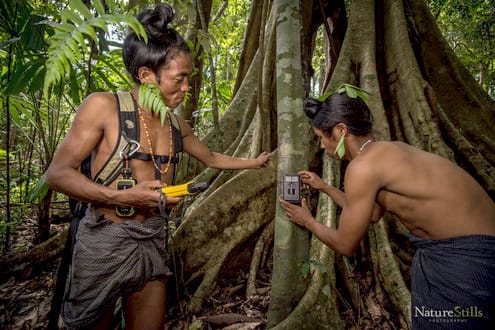
Forests are used sustainably by indigenous communities for fuelwood, food, and medicine.

Out of a total area of 2 million ha of forestland, less than half of this area is covered with trees.

In Bangladesh, railway construction projects, driven by development needs, are contributing to deforestation and fragmentation of forest areas.

While railways offer transportation benefits, their expansion through forested regions, including protected areas, has led to habitat loss, wildlife displacement, and increased human-wildlife conflict.

Deforestation and fragmentation contribute to biodiversity loss as species struggle to survive in reduced and isolated habitats.

Deforestation in Bangladesh, particularly in the Sundarbans mangrove forest, negatively impacts coral reefs. Deforestation leads to increased sediment runoff into the ocean, which smothers coral reefs. It also contributes to climate change through greenhouse gas emissions, causing coral bleaching and habitat destruction.

Some sources quote satellite surveys and note that forests are declining at a rate of nearly 70,000 ha per year, and Bangladesh has less than 0.02 ha of forest land per person, one of the lowest forest-to-person ratios in the world. If the current trend continues, forests are likely to disappear altogether in the next 35-40 years or earlier.

Continued deforestation implies that valuable species may disappear forever. In addition to habitat loss, the environmental effects of deforestation include soil degradation, flooding, erosion and above all, the danger of climate change.
Causes for Deforestation in Bangladesh
Deforestation in Bangladesh is driven by a complex mix of human, economic, and environmental factors:

● Population Pressure
High population density (over 1,200 people/km²) increases demand for:
Land for housing and agriculture;
Fuelwood for cooking and heating;
Forests are cleared to accommodate expanding settlements and farming.

● Agricultural Expansion
Forest lands are converted to:
Rice paddies;
Cash crops;
Shrimp farming (especially in the coastal southwest);
Shifting cultivation (jhum) in the Chittagong Hill Tracts continues to degrade forests.

● Logging Legal and Illegal
Commercial logging of valuable timber (teak, garjan) — sometimes poorly regulated.
Illegal logging is widespread due to:
Corruption;
Weak enforcement;
Poverty-driven exploitation;
Overharvesting often exceeds natural regrowth.

● Urbanization & Infrastructure
Forests are cleared for:
Road construction;
Industrial zones;
New towns and housing projects;
Dhaka, Chittagong, and other cities have expanded into forested areas.

● Shrimp Farming & Wetland Conversion
Mangrove forests (Sundarbans) were cleared for shrimp aquaculture.
Alteration of ecosystems leads to salinity intrusion and permanent forest loss.

● Resource Extraction
Hill forests are degraded by:
Stone quarrying;
Brickfields;
Charcoal production;
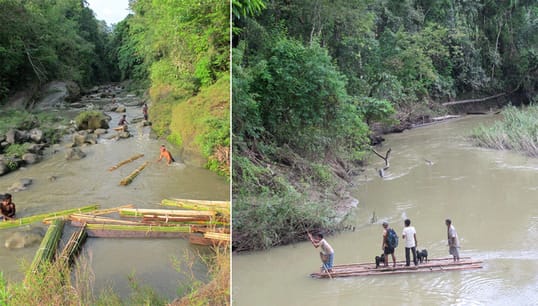
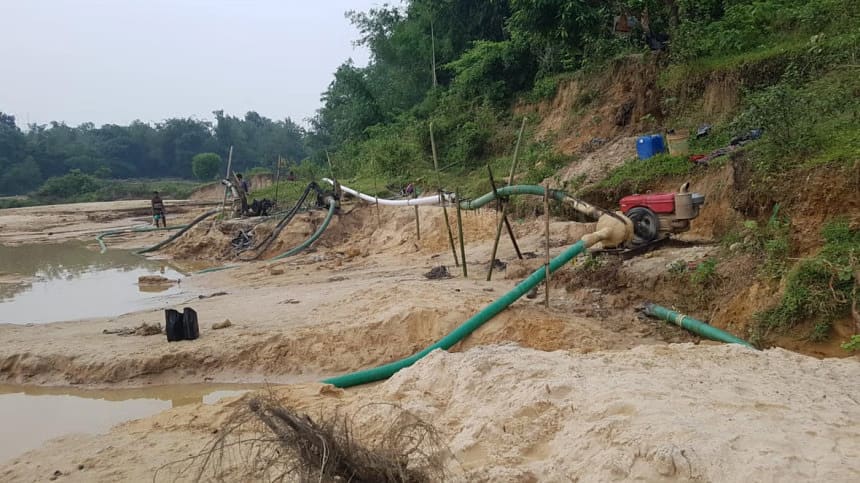
Mining and unregulated sand extraction also disturb forest ecosystems.

● Natural Disasters & Climate Change
Cyclones, floods, and tidal surges damage coastal forests like the Sundarbans.
Rising sea levels and salinity from climate change threaten forest regeneration.

● Weak Governance and Policy Gaps
Lack of coordination between land-use and forest management policies.
Encroachment due to unclear land tenure and forest boundaries.
Insufficient funding and staffing for the Bangladesh Forest Department.

● Livelihood Dependency
Rural poor depend heavily on forests for:
Fuelwood;
Fodder;
Timber and non-timber forest products (NTFPs);
Unsustainable extraction by millions of forest-dependent people accelerates degradation.
Gallery
5
Timelines
2025
February
Illegal sand extraction from hilly areas in Chunarughat (Habiganj) led to the razing of hills, encroachment into forests, and damage to water bodies.

Locals claimed several groups of sand traders are engaged in a competition to extract sand and soil illegally by razing hills in different areas within the upazila, including Gadhachhara of Kalinagar union and areas near Panchhari Eco Resort and Lalchand Tea Garden in Shankhola union.

The sand lifters are not only damaging hills but also encroaching on local forests and waterbodies, deploying excavators in almost every location to mine sand.

Seizing sand-lifting equipment during these drives has had little impact on stopping the illicit activities. Although some individuals have been arrested, they were later released on bail and soon resumed sand extraction.
2024
October
Illegal sand mining inside forest reserves. Raghunandan Hill Reserve Forest (Habiganj) witnessed excavation by excavators over ~20 acres, destroying forest land, increasing soil erosion, landslide risk, and threatening biodiversity in and around Satchhari National Park.
Illegal sand mining puts the forest at risk.
It lost 17.7 kha of natural forest, equivalent to 9.68 Mt of CO₂ emissions.

PRIMARY FOREST LOSS IN BANGLADESH:
From 2002 to 2024, Bangladesh lost 8.85 kha of humid primary forest, making up 3.4% of its total tree cover loss in the same period. The total area of humid primary forest in Bangladesh decreased by 9.2% in this period.

TREE COVER LOSS IN BANGLADESH:
From 2001 to 2024, Bangladesh lost 262 kha of tree cover, equivalent to 13% of the 2000 tree cover area, and 152 Mt of CO₂e emissions. This does not account for gains in tree cover over the same period.
2023
November
The railway line connecting Chattogram and Cox's Bazar in Bangladesh was inaugurated.
This 102-kilometer dual-gauge railway line is a major infrastructure project in Bangladesh aimed at boosting tourism and regional connectivity.

While the railway line offers significant economic benefits, it also raises concerns about deforestation and its impact on wildlife and ecosystems.

The railway line passes through several reserved forests, including the Chunati Wildlife Sanctuary, Fasiakhali Wildlife Sanctuary, and Medakacchapia National Park.
These forests are part of a corridor used by Asian elephants.
Environmentalists are concerned about the potential loss of trees and habitat for wildlife.

Deforestation can lead to habitat loss, fragmentation, and increased risk of human-wildlife conflict.
The project could also disrupt wildlife migration routes and increase the risk of accidents involving animals.

The railway line's construction may also affect aquatic ecosystems in the Karnaphuli River and other water bodies.

The project requires careful environmental impact assessments and mitigation measures to minimize damage to forests and wildlife.

This includes measures like wildlife crossings, reforestation efforts, and careful management of water resources.
2021
December
Saint Martin’s Island in Bangladesh is an ideal habitat for corals, mainly due to its diversified and enriched ecosystem and marine environment, but studies now show that its coral colonies have been steadily declining.

Sayeed Mahmood Belal Haider, director general of the Bangladesh Oceanographic Research Institute (BORI), in a study paper published, said the only 7.3 kilometer long island has been experiencing a coral bleaching event between 2018 and 2021.
November 02
The Glasgow Declaration on Forests and Land Use was signed during the COP26 climate conference in Glasgow.

Over 100 countries pledged to end and reverse deforestation by 2030, committing to conserve forests, promote sustainable development, and increase financial incentives to support these goals.

Bangladesh has signed the Glasgow Leaders' Declaration on Forests and Land Use, where the country pledged to end or reduce deforestation by 2030.
2020
Forest cover is estimated at around 11–14% (FAO & local estimates).

Afforestation and reforestation projects continue with donor support (e.g., ADB, World Bank).
2016
The government aims to increase forest cover to 20% under the Bangladesh Forest Policy 2016.
Emphasis on:
● Climate resilience
● Protecting the Sundarbans (a UNESCO World Heritage Site)
● REDD+ initiatives (Reducing Emissions from Deforestation and Forest Degradation).
2010
Satellite imagery confirms further forest degradation, indicating ongoing deforestation and changes in land cover.

This degradation is evident through analyses of Landsat imagery, which have shown a decline in forest cover and an increase in areas like settlements and bare land.

These changes highlight the need for effective forest management and conservation strategies to mitigate further degradation.
2007
Cyclone Sidr severely damaged the Sundarbans.
The South Asian floods ravaged areas across the country, leaving five million people displaced, with a death toll of around 500.
2005
As a reaction to the negative socioeconomic and ecological impact of conventional farming methods, organic shrimp aquaculture has been introduced to the southwest region of Bangladesh as an alternative culture.

The Organic Shrimp Project (OSP) was initiated in Bangladesh by the Swiss Import Promotion Program (SIPPO).

Shrimp farming and the associated conversion of wetlands in Bangladesh negatively affect deforestation.
This is primarily due to the clearing of mangrove forests to make space for shrimp ponds. Mangroves, which are vital coastal ecosystems, are often destroyed to expand shrimp farming operations. This destruction leads to deforestation and has significant ecological and social consequences.
2000
Continued forest loss due to:
● Illegal logging
● Encroachment
● Shrimp farming in the Sundarbans
● Infrastructure (roads, settlements)

Introduction of Social Forestry Programs and Community-Based Forest Management.
1998
September
Bangladesh saw the most severe flooding in modern history, after which two-thirds of the country went underwater, along with a death toll of 1,000.
1995
The Bangladesh Environment Conservation Act was enacted.
1990
Post-Independence (1971–1990s) Rapid population growth and rural poverty drove deforestation for:
● Fuelwood
● Agricultural land
● Urban expansion

Major deforestation in the Chittagong Hill Tracts due to shifting cultivation (jhum).

40 percent of forestlands have been lost from 1960 to 1990.

Deforestation rose to 2.7 percent in 1984-1990.
1989
Up to 1989, about 76,596 ha of forestland had been encroached upon in different forest areas. According to one estimate, forest cover in Bangladesh has declined from about 15 percent of the total area to 5 percent.
1972
Bangladesh Forest Department (BFD) was formed.
1971
East Pakistan Period (1947–1971) Large-scale population growth and refugee settlement after Partition increased forest pressure.

The government promoted agricultural expansion, clearing forests in the Chittagong Hill Tracts and sal forests.

Logging intensified, but forest regeneration was not prioritized.
1970
The deforestation rate was 0.9 percent in 1970.
1947
In the Colonial Period (1757–1947), Commercial Logging Begins: British rulers exploit forests for timber, shipbuilding, and railway sleepers.
Forest Act passed in 1878 - formal state control over forests begins.

Deforestation accelerated due to railway expansion, jute cultivation, and clearing for settlements.