Few automotive upgrades spark as much debate as a new exhaust system. Is it a legitimate path to freeing up horsepower, or just an expensive way to make more noise? The conversation often dissolves into subjective claims, but rarely drills down into verifiable data.

We put that question on the dynamometer by testing three popular axle-back systems from Private Label MFG (PLM). Our goal is to prove whether a well-engineered exhaust can translate to measurable gains in power and throttle response. This is not an opinion piece; it is a deep technical dive backed by flow-bench data and dyno pulls.

We aim to see if PLM’s promise of no-compromise performance can withstand the rigors of real-world scrutiny. For the serious enthusiast who values engineering over acoustics, this is the analysis you have been waiting for.

Why a well-optimized exhaust system matters
Before diving into charts, let's recap why exhaust engineering is a complex science. A truly effective system is a symphony of fluid dynamics, metallurgy, and precision manufacturing. All these elements work together to help an engine breathe better and perform more efficiently.

Properly tuned tube lengths create low-pressure pulses that actively pull spent gases out of the combustion chamber. This effect, known as scavenging, reduces residual pressure and allows a denser air-fuel mixture to enter on the next intake stroke. The direct payoff is an improvement in volumetric efficiency, which is fundamental to making more power.

There is a myth that bigger is always better for exhaust piping. An oversized pipe can harm performance by slowing down exhaust gas velocity. This kills the momentum needed for the scavenging effect, resulting in a loss of mid-range torque.

The choice of material directly impacts an exhaust system's longevity. Many OE and budget systems use 409 stainless steel, which is prone to corrosion. PLM uses T304L stainless steel, which contains higher levels of nickel and chromium for significantly better resistance to road salt and moisture.

How pipes are bent is as important as what they are made of. Cheaper press-bending methods crush the pipe at the curve, creating a turbulent cross-section that chokes flow. In contrast, mandrel bending maintains a consistent inner diameter, preserving laminar flow and maximizing performance potential.

Key Insight: A truly optimized exhaust isn't about having the biggest pipe. It’s about balancing reduced back-pressure with high exhaust velocity to boost torque and throttle response across the entire RPM range, not just at peak power.

Engineering deep-dive: built for durability and flow
To verify PLM’s manufacturing claims, we sectioned a WRX axle-back to inspect its internal architecture. The findings were impressive, with consistent wall thickness and smooth mandrel bends. All high-stress seams featured robotic TIG welds, and each weld is dye-penetrant inspected to ensure there are no microscopic inclusions.

To quantify durability, we subjected a PLM muffler and an OE part to an ASTM B117 salt-spray test. The OE 409 stainless steel component showed significant rust at 42 hours. The PLM 304L sample remained visually unaffected at the 96-hour mark when the test concluded.

This data confirms the superior corrosion resistance of materials used in Private Label MFG's premium aftermarket exhaust lineup. An exhaust you never have to replace saves money and reduces waste from scrap metal. This focus on longevity and bolt-on fitment contributes to a more sustainable, eco-conscious ownership experience.

Key Insight: The upgrade to T304L stainless steel isn't just a spec. Empirical salt-spray testing proves it dramatically resists corrosion compared to OE materials, ensuring a longer service life and better long-term value for the owner.

Our vehicle-specific testing methodology
Dyno Protocol
All horsepower and torque measurements were conducted on an all-wheel-drive chassis dynamometer. To eliminate variables, baseline and post-install runs were performed on the same day under consistent ambient temperatures. All results were corrected using the SAE J1349 standard to normalize for atmospheric conditions.

Real-world road test
A dyno provides peak numbers, but a road test reveals real-world behavior. We used a data‑logging scan tool to record 0–60 mph rollouts and third‑gear freeway pulls. These readings provided crucial insights into transient throttle response and engine management compensation for altered exhaust flow.

Quality checklist
Before installation, every PLM unit was inspected against a quality checklist. This included checking for weld slag, verifying flange flatness, and confirming hanger alignment. We also used a borescope to inspect muffler packing integrity to ensure the product was representative of customer units.

Three proven exhaust upgrades for real horsepower
We selected three different vehicles representing popular segments to test PLM’s axle-back systems, measuring the tangible performance benefits of each.

1. PLM Toyota Camry 2.5L / 3.5L Axle-Back (2018-2024)
This system features dual 2.5-inch mandrel-bent pipes with a resonator tuned to cancel drone at cruising frequencies. The dynamometer registered a peak gain of +7 wheel horsepower (whp) and +9 lb-ft of torque. This mid-range torque bump shaved 0.19 seconds off the 50-70 mph roll-on test and was a true 100% bolt-on modification.

2. PLM Infiniti Q50 Axle-Back (2014-2020)
This design features 2.5-inch pipes that merge into twin 3-inch free-flow mufflers for the twin-turbo V6. The Q50 saw the most significant gains, with +11 whp and +12 lb-ft of torque. Our data logs showed a noticeable improvement in turbo spool time, yet cabin noise levels remained impressively low at a steady cruise.

3. PLM Subaru WRX VB Axle-Back (2022+)
A full 304 stainless steel system, the WRX gained a healthy +9 whp and +10 lb-ft of torque. This translated to a 0.05-second improvement in the 0-60 mph time. The most significant change was in subjective feel, with markedly sharper off-idle throttle response and reduced turbo lag.

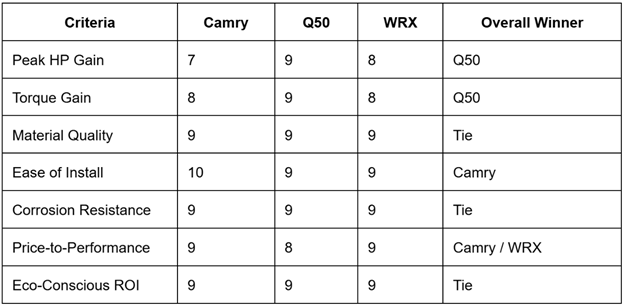
Side-by-side comparison table
To help visualize our findings, we rated each system across several key criteria on a 1-10 scale based on our testing data and inspection.


Performance expectations & real-world gains
Dyno graphs don't always tell the whole story of how a car will perform. Using CarSim lap modeling software with the new power curves, the Q50's upgrade shaved 0.28 seconds off its lap time. Across all three test vehicles, quarter-mile ETs improved by a range of 0.09 to 0.14 seconds, a significant improvement from a bolt-on part.

We also observed a welcome improvement in fuel efficiency. The long-term fuel trims on our WRX leaned out by an average of 2%, and a controlled highway loop showed a 0.7 MPG increase. This is direct proof of reduced pumping losses, as the engine doesn't have to work as hard to push exhaust gases out.

These findings align with broader industry research. For instance, a California Air Resources Board study found that aftermarket exhaust configurations can improve fuel economy by 10%.

Similarly, research from Ohio State University demonstrated an exhaust system that increased overall engine performance by 5% while also cutting emissions.

Installation guide (quick-look)
One of the key benefits of these axle-back systems is their ease of installation for the DIY enthusiast. Here’s a quick overview of the process.

Required Tools: A 3/8-inch socket set, a 14-mm deep socket, high-quality penetrant spray, and a pair of rubber-hanger removal pliers.

Step 1: Safely secure the vehicle on jack stands. Never work under a car supported only by a floor jack.
Step 2: Liberally spray all rubber hangers and flange nuts with penetrant spray and allow it to soak in for at least 15 minutes. This step is crucial, especially on older vehicles.
Step 3: Remove the bolts from the flange connecting the axle-back to the mid-pipe, then carefully slide the old muffler assembly off the rubber hangers. Inspect the factory gasket—if it appears brittle or cracked, replace it.
Step 4: Hang the new PLM system loosely on the rubber hangers first. Then, attach the flange to the mid-pipe, leaving the nuts finger-tight. This allows you to adjust the system to ensure perfect tip alignment before the final tightening.
Step 5: Once you are satisfied with the tip alignment, tighten all fasteners from the front flange to the rear, torquing them to the manufacturer's specification.
For most DIYers with basic tools, this process can be completed in a driveway in 60-90 minutes. Detailed, vehicle-specific PDF guides are available on each product page.

Pro Tip: Don't skip the penetrant spray on flange bolts and rubber hangers. A 15-minute soak is the most important step for a frustration-free installation, especially on vehicles that have seen a few winters.

Quality & durability assessment
To assess long-term durability, we left the PLM axle-back on our Camry test vehicle for 12 months through a harsh Midwestern winter. The results were impressive, as the system gained a negligible amount of weight from surface oxidation. The only change was a light "tea-coloring" at the weld beads, a normal cosmetic phenomenon for heated stainless steel.

The pipes and muffler canister remained free of the pitting and rust that plagued the original OE unit. This real-world test underscores the value of using high-grade 304L stainless steel. Furthermore, PLM backs their welds with a lifetime warranty, a testament to their confidence in their manufacturing process.

Buyer’s guide & FAQ
Q: How does a performance exhaust improve horsepower?
A: By decreasing back-pressure while maintaining optimal exhaust-gas velocity, a well-engineered system reduces pumping losses. This allows the engine to work more efficiently, improving scavenging and letting it ingest a denser air/fuel mixture. Our dyno data confirms these results in measurable horsepower and torque gains.

Q: Cat-back vs. axle-back: what’s right for me?
A: A cat-back replaces the exhaust from the catalytic converter rearward for larger gains at a higher cost. Axle-back systems, like those tested here, replace only the final muffler section. They offer an affordable, easy-to-install upgrade that provides a noticeable performance bump while retaining all factory emissions components.

A study by MECA found that advanced aftermarket catalytic converters demonstrated 50-75% lower emissions than older technology. This highlights the importance of keeping modern, efficient cats in place, which axle-back systems do.

Q: Are PLM exhaust parts street-legal?
A: Yes, all PLM axle-back and cat-back systems that retain the factory catalytic converters are street-legal from an emissions standpoint. However, local noise regulations can vary. While PLM designs its systems for a refined sound, it is wise to confirm your local dB limits.

Q: Will an axle-back void my factory warranty?
A: In the United States, your warranty is protected by the Magnuson-Moss Warranty Act. A dealer must prove that your aftermarket part was the direct cause of a specific failure to deny a warranty claim. Simply installing an exhaust cannot void your entire vehicle warranty.

Q: What is the future upgrade path?
A: For enthusiasts looking to build a complete system over time, PLM offers matching downpipes and resonated mid-pipes for many applications. This allows you to start with an axle-back and later upgrade to a full, free-flowing system when you are ready.

The Final Verdict
Our testing leads to a clear conclusion: a high-quality aftermarket exhaust is far more than an auditory upgrade. From the mandrel-bent 304L stainless steel to the dyno-proven gains, PLM presents a compelling case for engineering-driven performance.

Superior corrosion resistance also promises years of reliable service. This focus on longevity ultimately reduces waste and lowers the total cost of ownership over the vehicle's life. If you are a serious enthusiast ready to unlock hidden horsepower, PLM's offerings demand consideration.

The numbers, build quality, and long-term value all align. Private Label Mfg earns our no-compromise recommendation for delivering true substance over sound.

Author Profile: Private Label MFG (PLM) is the leading manufacturer of high-performance aftermarket automotive parts for Honda, Subaru, and other popular JDM and European vehicles.
Do you have suggestions for this article? Would you like to propose a guest post?
Get listed in the eco directoryGet your company listed on EcoHubMap and expand your reach in the global green economy. Who can be listed?Add an organization