Running a community sports event with less waste comes down to four practical habits: using the supplies you already own, making the most of existing team kit, planning waste stations before the day, and coordinating transport through channels you already use.
None of these requires a sustainability background or a new budget line. They need a shared document, a venue map, a group chat, and a look inside the storage room.
Start with reusable event supplies
Most sports organizations accumulate reusable event supplies across seasons without ever taking a full inventory. Timing cones, pop-up tents, banner frames, registration tables, finish-line tape, and coolers tend to migrate between storage rooms and vehicle trunks, and they often get repurchased because no one can confirm where the originals went.
A shared spreadsheet updated after each event helps prevent that cycle. Log each item's condition and storage location. A lending system between teams or schools in the same area can stretch inventories further. Think of it as a tool library rather than a donation program: each organization keeps ownership of its items and logs them out to neighboring groups for specific events.
Make the most of existing team kit
The most frequently skipped step in gear planning is checking current inventory before authorizing a purchase. Coaches often default to a full reorder because establishing a record of existing apparel takes time, and buying a fresh set feels faster than digging through storage bins.
A simple spreadsheet kept after each season changes this. Track the condition, size, and athlete assignment for every uniform piece as it returns, and the next inventory check becomes a quick task.
Targeted replacement ordering then becomes the standard procedure. A school track team, for example, can check what can be reused, sort the returning items by condition, and plan a replacement order for the gaps, such as track uniforms from Sports Gear Swag for a considered team order. Filling specific gaps instead of replacing the whole roster can cut costs and reduce unused inventory.
Plan waste stations before the day
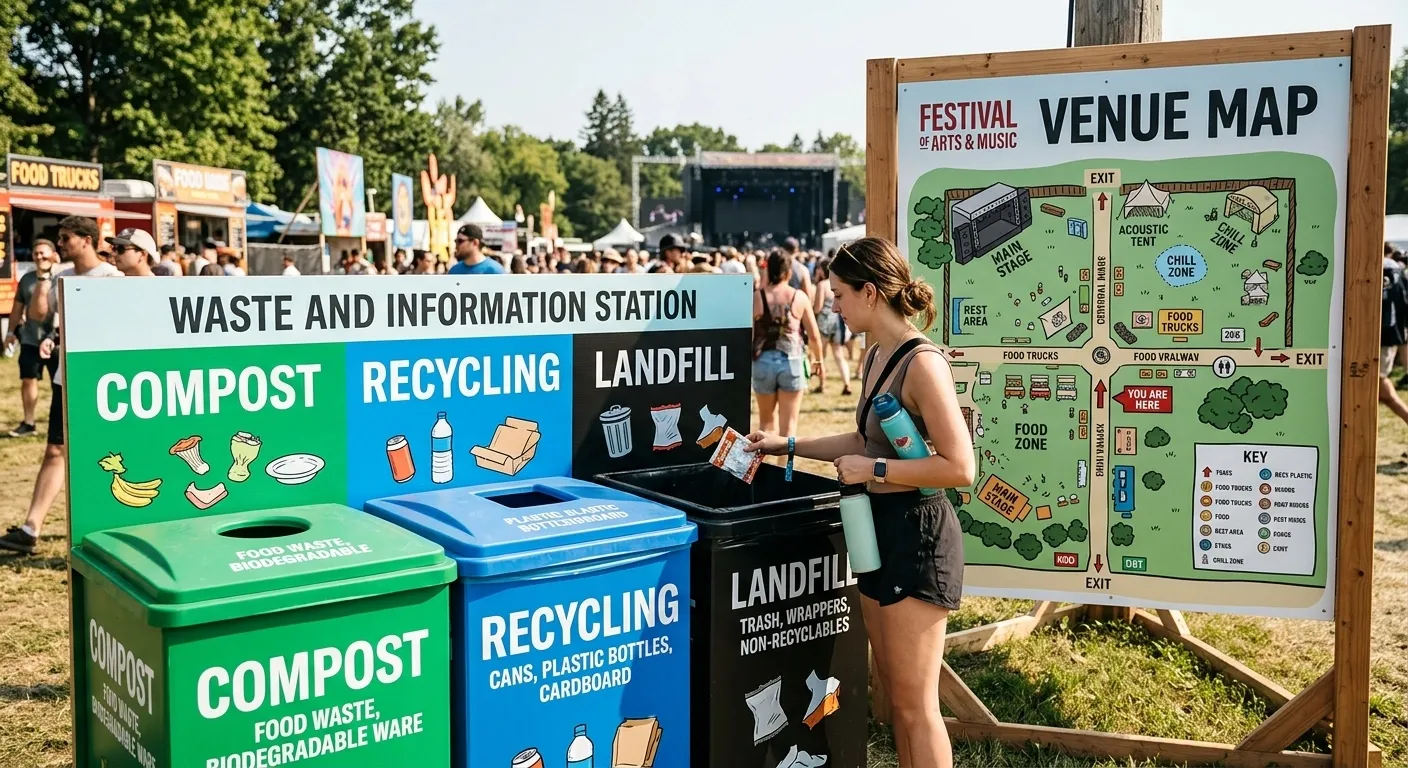
(Credit: Visual concept generated by EcoHubMap with AI)Unlabeled or poorly placed bins at community events tend to produce mixed waste streams and longer cleanup. An EPA assessment found that sports venues generated approximately 38,088 tons of excess food and food waste. Landfilled food waste accounts for an estimated 58 percent of fugitive methane emissions from municipal solid waste landfills, so diverting it can make a real difference to an event's footprint.
Start by mapping the highest-traffic zones, such as the water station, food distribution points, and spectator seating. Each zone needs clearly labeled bins for compostables, recyclables, and general waste, because a single recycling bin at the entrance handles little when most waste is generated at the point of consumption. Assign a few volunteers to monitor stations during peak hours.
Before finalizing the setup, confirm which material streams the venue actually collects, because a sorting system the local facility cannot process wastes everyone's effort. Ohio State University, for example, reports a 96% waste diversion rate inside its stadium, where diversion means waste that is composted or recycled instead of landfilled.
Pro Tip: Treat bin placement as logistics, not an afterthought. Walk the venue before the event and confirm that every station is easy to reach and easy to empty.
Coordinate shared transport early
The main barrier to shared transport is usually administrative rather than logistical. Organizers often assume carpooling needs new software, though group chats, email lists, and team apps can handle coordination through a single message thread.
Shared transport works best for full-day tournaments at a single venue, especially when several teams from the same school district depart from a clustered area. Gather passenger counts a week before the event so there is time to adjust vehicle assignments.
Key Insight: Name one carpool coordinator per team or grade level. One person managing the thread removes the need for every family to negotiate individual rides.
Putting it all together
A shared inventory document updated after each event, a waste-station map drawn before the venue day, and a single group message to identify carpool interest are enough to start. Each habit is small on its own, and together they reduce the supplies, uniforms, and waste that a community event would otherwise add.
Do you have suggestions for this article? Would you like to propose a guest post?
Get listed in the eco directoryGet your company listed on EcoHubMap and expand your reach in the global green economy. Who can be listed?Add an organization