- green-spots
- energy
- USA
- Solar Panels Over Water Canals, USA
Problems
Arizona and California face acute environmental challenges, including chronic water shortages, droughts, and extreme heat, exacerbated by climate change.

High temperatures require more energy for cooling, increasing the risk of wildfires.

California, in particular, suffers from smog and greenhouse gas emissions, despite the development of renewable energy.

Persistent drought conditions, climate change, and increased water demand are among the factors contributing to the shrinking of river basins and reservoirs in the United States. The Colorado River basin is an example.

The Colorado River flows through several US states, including Arizona and California, and is a key source of drinking water and agricultural irrigation.

The Colorado River Basin has suffered from drought throughout the 21st Century, driving the dangerously low water levels at the reservoirs.

The Colorado River faces crisis-level depletion due to drought, warming temperatures, and declining snowpack in the Rockies.

Intense sun and heat in the arid region cause significant water loss—1 to 2 million acre-feet annually in the Colorado River Basin.

Due to overuse and climate change, water levels in the river and associated reservoirs (Lake Mead) have declined critically, forcing authorities to impose restrictions.

Placing solar panels over canals thus offers a synergistic solution, combining water conservation and a shift to solar energy.

Indigenous Peoples often face outsized challenges from climate change. For the Gila River (GRIC) Indian Community, this solar-over-canal initiative is a step toward cleaner energy and reduced dependence on fossil fuels, the leading driver of global warming.

Panels over water operate more efficiently due to natural cooling, eliminating the problem of reduced efficiency in hot weather.

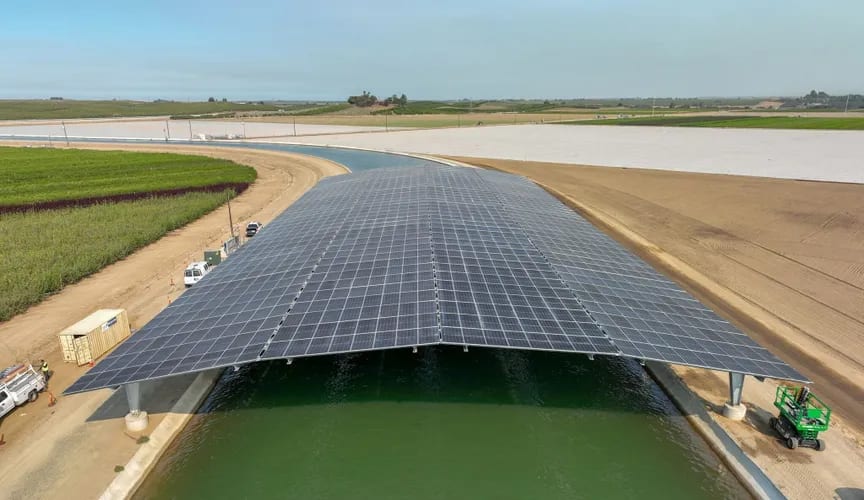
Building solar panels over canals in Arizona (Casa Blanca) and California serves to maximize efficiency in the drought-stricken Southwest by simultaneously generating renewable energy, reducing water loss from evaporation (1-2% annually in CA), minimizing algae growth, and conserving land. The shade keeps panels cool, boosting electricity production.
Solutions
Solar panels over the Casa Blanca canal
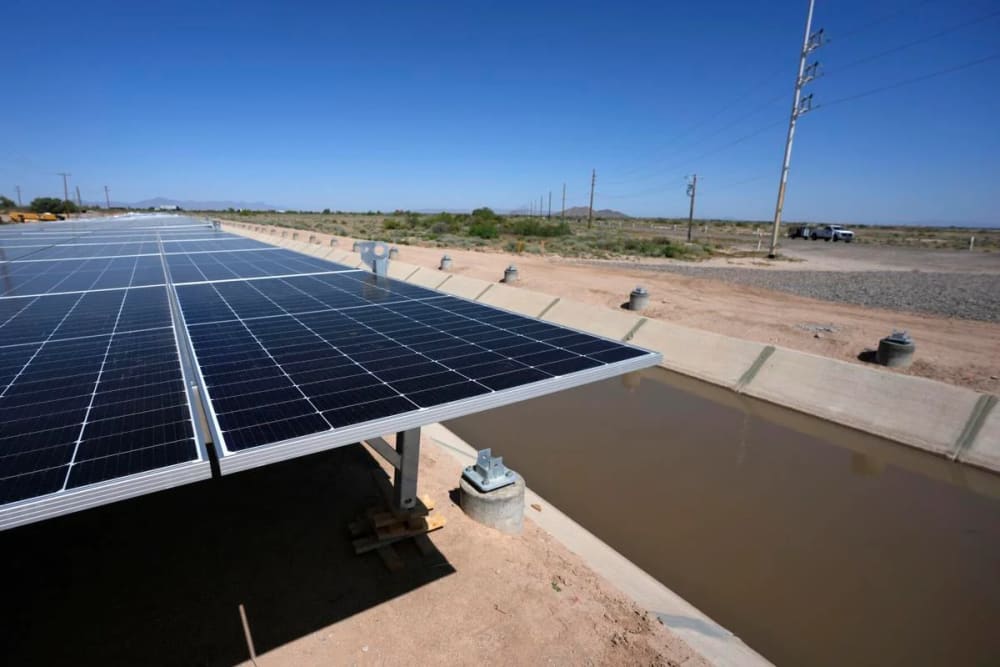
The Gila River (GRIC) Indian Community began installing the groundbreaking Casa Blanca canal solar project of 3,000-foot-long solar panels situated over the Casa Blanca canal. This project is notable for being the first of its kind in the Western Hemisphere. It was designed to cover irrigation canals with solar panels to reduce water evaporation and generate renewable energy.

The Solar-Over-Casa Blanca Canal Project, located 33 miles south of Phoenix, Arizona, serves a dual purpose:
• Generate clean, renewable energy
• Reduce water evaporation in the desert sun and wind

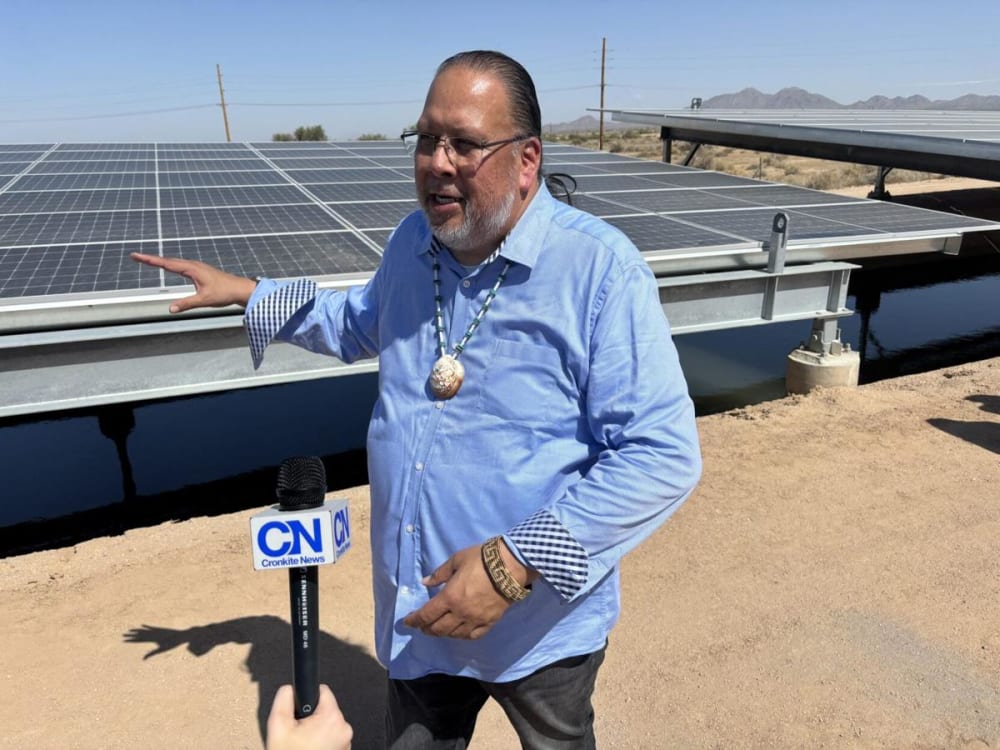
According to Dr. David H. DeJong, Director of the Pima-Maricopa Irrigation Project, the solar array is capable of generating up to 1.3 megawatts of power.

A five-year study is underway to gather data on the project’s effectiveness. Initial findings suggest the solar cover may reduce evaporative losses by 40% to 65%.

The canal itself spans over 250 miles. Covering just half of it with solar panels could produce more than enough electricity to meet the community’s needs—potentially opening up opportunities for carbon credit trading and selling excess power to outside entities.

Given Arizona’s abundant sunshine and growing water stress, investing in solar panels over canals makes practical and ecological sense. It also eliminates the need to use additional land, aligning with the community’s values of sustainable resource use.

The project, which is part of a larger, long-term plan to cover 16 miles of canal, aims to conserve water in the drought-stricken region, notes the Climate Adaptation Platform.
California’s Project Nexus
A novel solar power project just went online in California’s Central Valley, with panels that span across canals in the vast agricultural region.

The 1.6-megawatt installation, called Project Nexus, was fully completed. The $20 million state-funded pilot has turned stretches of the Turlock Irrigation District’s canals into hubs of clean electricity generation in a remote area where cotton, tomatoes, almonds, and hundreds of other crops are grown.

Project Nexus is only the second canal-based solar array to operate in the United States — and one of just a handful in the world.

In California, the solar-canal system was built in two phases, with a 20-foot-wide stretch completed in March and a roughly 110-foot-wide portion finished at the end of August.

Researchers will study the project’s performance over time, while a new initiative led by California universities and the company Solar Aquagrid will push to fast-track the deployment of solar canals across the state.

Proponents of this emerging approach say it can provide overlapping benefits.

Early research suggests that, along with producing power in land-constrained areas, putting solar arrays above water can help keep panels cool, in turn improving their efficiency and electricity output. Shade from the panels can also prevent water loss through evaporation in drought-prone regions and can limit algae growth in waterways.

Plus, solar canals could offer a faster path to clean energy development than utility-scale solar farms, especially in rural parts of the U.S., where big renewables projects increasingly face community opposition. Placing solar panels atop existing infrastructure doesn’t require altering the landscape, and the relatively small installations can be plugged into nearby distribution lines, avoiding the cumbersome process of connecting to the higher-voltage wires required for bigger undertakings.

The purpose of these early arrays is primarily to power on-site canal equipment like pumps and gates. But such projects could eventually help clean up the larger grid, too. A coalition of U.S. environmental groups previously estimated that putting panels over 8,000 miles of federally owned canals and aqueducts could generate over 25 gigawatts of renewable energy — enough to power nearly 20 million homes — and reduce water evaporation by possibly tens of billions of gallons.
Gallery
5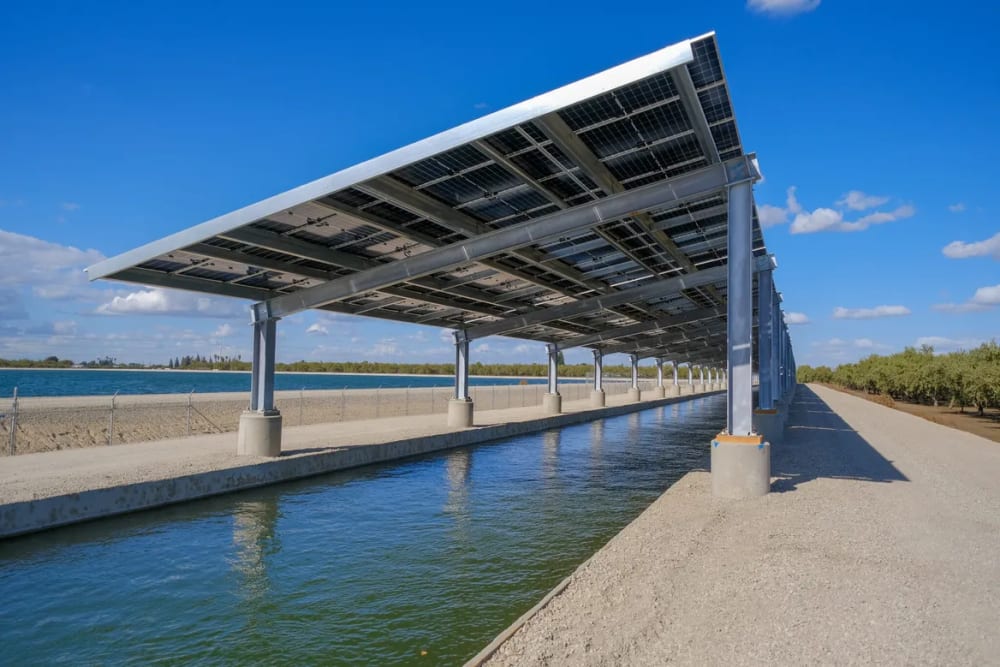

Timelines
2007
While floating solar panels are not new—they were first deployed in 2007 in Napa County, California—they’ve matured slowly in the U.S.
2015
California's dry earth was crunching under a fourth year of drought. Governor Jerry Brown ordered an unprecedented 25 percent reduction in home water use. Farmers, who use the most water, volunteered to avoid deeper, mandatory cuts.

Brown also set a goal for the state to get half its energy from renewable sources, as climate change bears down.
Between 2001 and 2015, Lake Mead’s water level fell by 121 feet.
2022
August
The Inflation Reduction Act (IRA) is a landmark U.S. federal law aimed at fighting climate change, lowering healthcare costs, and reducing the deficit. It invests approximately $370 billion in clean energy and climate initiatives, aiming to reduce carbon emissions by ~40% by 2030.

Unprecedented investments in solar, wind, and electric vehicles (EVs), including consumer tax credits for home energy upgrades and EV purchases. Including funding for initiatives to reduce pollution in disadvantaged communities.

The IRA was designed to be a 10-year plan, with many provisions aimed at long-term economic and environmental shifts, including promoting domestic manufacturing of clean technology.
2023
July 19
A group of organizations and Greenpeace sent a letter to the U.S. Bureau of Reclamation, urging the acceleration of solar photovoltaic system implementation over water canals and aqueducts. The letter highlighted the potential for reducing water evaporation while generating renewable energy.

The groups noted such action could pull the U.S. into compliance with the Energy Act of 2020, which pledged to seek to permit leases for at least 25 gigawatts of electricity from wind, solar, and geothermal projects on federal land by 2025.
The letter was part of a broader advocacy effort by environmental groups aimed at increasing sustainable infrastructure.
2024
The American Renewable Energy Act (AREA), introduced in late 2024 by Rep. Yvette Clarke, aims to drastically reduce U.S. carbon emissions by establishing a 70% renewable energy resource standard by 2034 and up to 100% by 2044. This bicameral legislation prioritizes solar, wind, geothermal, marine energy, and efficiency, specifically investing in impacted communities.

The act aims to transition the U.S. power grid away from fossil fuels by setting strict, increasing renewable energy requirements for electricity providers.
The bill seeks to reduce pollution, promote community resilience, and boost the clean energy economy.

It includes mechanisms to ensure that at least 50% of collected funds are invested in renewable energy, efficiency, and storage projects in impacted communities.

The scope covers wind, solar, geothermal, marine energy, small-scale hydropower, and methane digesters.
February
Work on Solar panels over the Casa-Blanca canal began in early 2024, and crews at the site by February.
October
According to Inside Climate News, the Arizona, Casa Blanca solar panels began producing power for members of GRIC’s two tribes: the Akimel O’odham (Pima) and the Pee Posh.
2025
February
Lake Mead’s water level fell by it had dropped even further, to 1,068 feet.
July
The 1.6-megawatt installation, called Project Nexus, was fully completed late in July. The $20 million state-funded pilot has turned stretches of the Turlock Irrigation District’s canals into hubs of clean electricity generation in a remote area where cotton, tomatoes, almonds, and hundreds of other crops are grown.